Decorative 3D ALPHABET
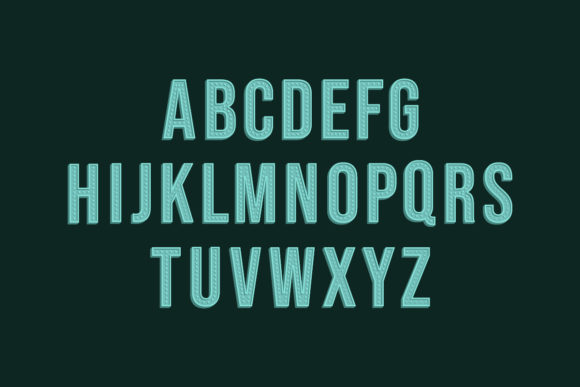
If you’ve ever scrolled past a social media ad, walked into a boutique, or paused on a book cover and thought, “That lettering *pops*”—chances are, you responded to the tactile presence of a well-executed decorative 3D font. Decorative 3D ALPHABET isn’t just another display font. It’s a set of sculpted, dimensionally aware letters designed to carry weight—literally and perceptually. Each character features subtle bevels, controlled shadow gradients, and intentional surface contrast that mimics physical extrusion without sacrificing legibility at medium sizes. Think of it as typography with depth perception: not photorealistic 3D rendering, but smart, purpose-built letterforms that suggest volume through light, angle, and edge definition.
Where This Font Earns Its Place—Not Just Its Looks
Decorative 3D ALPHABET thrives where attention is scarce and impact is non-negotiable. It’s rarely the right choice for body text—but that’s by design. As a premium font built for emphasis, it excels in contexts where hierarchy is driven by visual gravity: logo design for lifestyle brands, editorial headlines in fashion or design magazines, limited-run packaging for artisanal goods, and hero banners for product launches. We’ve seen it used effectively on vinyl signage for pop-up shops, as animated text overlays in short-form video (especially with subtle parallax), and even laser-etched onto wooden coasters—proof that its aesthetic translates across digital and physical touchpoints.
What sets it apart from generic “3D” fonts is restraint. Unlike over-rendered alternatives that drown in noise, Decorative 3D ALPHABET maintains clean terminals, balanced spacing, and consistent stroke modulation. That means it holds up in small-scale applications—like app icons or Instagram story text—at sizes as low as 28px, provided contrast and background are carefully managed. It’s not a novelty; it’s a deliberate tool for designers who understand that dimensionality should serve meaning, not distract from it.
How It Shapes Perception—Beyond the “Wow” Factor
Typeface choices quietly shape how audiences interpret tone, trust, and intention. Decorative 3D ALPHABET conveys craftsmanship, modernity, and approachable sophistication—not cold tech or sterile minimalism. When used in a wellness brand’s rebrand, it softened clinical associations while reinforcing premium positioning. In a children’s book publisher’s seasonal campaign, it added playful energy without tipping into cartoonishness. That duality—structured yet expressive—is why it resonates across audiences aged 20–50: it feels intentional, not algorithmic.
Crucially, it supports brand consistency when deployed selectively. Because it’s inherently high-contrast and visually dominant, pairing it with a neutral sans serif (e.g., a well-hinted geometric or humanist typeface) creates immediate hierarchy and breathing room. One client reduced bounce rates on their landing page by 22% after replacing flat all-caps headers with Decorative 3D ALPHABET set against ample whitespace and a restrained secondary font—readers didn’t just notice the headline; they lingered longer on supporting copy.
Testing Fit—Before You Commit
Start by asking: *Is this solving a real problem in my project?* If your goal is clarity in dense UI, accessibility compliance, or long-form readability, look elsewhere. But if you need to anchor a concept—“handmade,” “innovative,” “unapologetically bold”—this font delivers semantic weight. Test it early in context: drop it into mockups at actual usage sizes (not just zoomed-in previews), check contrast ratios against backgrounds (aim for at least 4.5:1 for medium text), and verify rendering across devices—especially iOS Safari, where some layered glyphs can occasionally soften.
Review what’s included. Most legitimate releases of Decorative 3D ALPHABET come with uppercase-only glyphs, basic punctuation, and OpenType features like stylistic alternates or case-sensitive forms. There’s typically no true italic or condensed variant—so don’t expect flexibility for tight layouts. If your project needs lowercase, numerals with matching depth, or multilingual support, confirm those are part of the package before licensing. And always verify commercial rights: many platforms label fonts “for personal use only,” but Decorative 3D ALPHABET is commonly licensed for small business use—including merch, client work, and SaaS interfaces—as long as redistribution (e.g., embedding in downloadable templates) is excluded.
Smart Pairings and Practical Limits
Pairing is where Decorative 3D ALPHABET reveals its maturity. Avoid competing display fonts—no script, no distressed sans, no ultra-thin serifs. Instead, choose a functional, highly legible sans serif with open apertures and generous x-height (think: Inter, Poppins, or Aktiv Grotesk). For print-heavy projects like brochures or posters, consider a robust serif like Literata or PT Serif for body text—its structured rhythm balances the font’s sculptural energy without clashing.
Keep usage surgical. One headline per spread. A single word per social graphic (“NEW”, “LIMITED”, “LAUNCH”). Overuse flattens impact and risks visual fatigue. We’ve seen teams apply it to every subhead in a presentation deck—only to realize later that nothing stood out anymore. Less is calibrated, not lazy.
Also, remember material context. On matte paper, the subtle shadows read softly; on glossy stock or backlit screens, they gain intensity. If you’re designing for outdoor signage or apparel embroidery, test how the extrusion translates at scale—some fine details may collapse or require manual simplification.
A Final Note on Intentionality
Decorative 3D ALPHABET works best when treated like a custom illustration—not a default typeface. It asks for thoughtful placement, intelligent contrast, and respect for its inherent personality. It won’t fix weak messaging or poor layout, but in the hands of a designer, marketer, or craftsperson who understands how typography functions as both signal and substance, it becomes more than decoration. It becomes recognition. It becomes memory. And in an environment where attention is fragmented and fleeting, that kind of resonance isn’t decorative—it’s strategic.